Lorne Hindbo, a good stockman from Alberta wanted a little more explanation on the changes in the bull that was a little tough to load. I’m glad he asked, and I’ll use some examples to not answer the question, but help you answer it in your own mind and how you can make it work for you.
[From bull video session-Zoetis sponsored this for “Bulls for 21rst Century” -they do not sponsor Stockmanship and Stewardship for NCBA]
The normal response when a bovine animal gets on the fight for most humans is fear or anger, and I’m not saying either one is wrong, neither one is best for changing the animals state of mind. If your hurt or dead your not going to change it much either, so fear is probably not the worst thing.
We used to live right next to a ranch that had buffalo. I asked Billy Gehring, the owner if he minded if we rode out there. He didn’t, but told me to stay clear of the buffalo as they would chase a horse.
Mesa was real young and had a great old horse named Painter. We were back there riding and got to close to the buffalo and they did take off after us. It scared me to death as they were serious, and I was scared for Mesa. The whole bunch of buffalo at a run right behind us. Mesa and old Painter were getting after it and I sure we were going to get run over. I remember riding back home and being so shook up as my eight year old daughter had been in so much danger of having her horse fall a dead run in slick rough country or by having some big old buffalo bull hook her horse. I think it was the first time (I’m pretty sure it was the last time) we rode back to the barn and she didn’t have much to say.
I paid to go to a Bud Williams stockmanship school (I hope that gives me the right to discuss it hear)not to long after the incident. Well I asked him about how to deal with the situation. After a little debate he told this story to the class.
This is my memory of it, so it’s not what Bud said, but my interpretation of it.
There was a sow grizzly bear with cubs that was killing reindeer where they were employed. He went out to where she was on a snow machine and approached not directly at her but in sort of a back and forth ribbon pattern. When he got close enough that she stood up and challenged him (1/2mile?)
He stopped the machine and stepped back a few steps and waited. He waited for her to change her mind and walk off, then started again until she felt the need to challenge again, stopped, stepped back and waited. After she realized that she could move away from pressure, and the pressure would not chase her, she could accept the pressure not fight it. He said he drove her and her cubs several miles to the where she could fish and she didn’t come back.
Again, it was many years ago and I’m sure it’s not exact, but you can get the idea. Knowing how ferocious grizzlys can be, that really helped me to see how important it is to understand to change the mind of an animal.
Of coarse when I got home I went to work on the buffalo (unknown to the Gehrings), and started with the bulls. I would ride a colt and approach the bunch of bulls and go to working my colt and watch the bulls. When they would get up, I would stop and back my horse up. They’d shake their big old heads and try to bluff me and I would just wait. They would go back to their own business and I would go back to doing a little with the colt a little closer. Pretty quick they would move away from my pressure rather than challenge it. Then I could put a little more pressure on and they would move away from it. I used those buffalo as a place to work my colts and it wasn’t many days and I could drive them anywhere and they actually seemed to enjoy it.
As I rode away that first day after making a change on the buffalo, it was quite similar to the feeling I got from loading the bulls. Confidence and satisfaction.
Totally different than the fear I felt with them chasing Mesa and me.
As you might know I have been dealing with bucking bulls quite a lot in the past ten years or so. Some of them are sorta like grizzly bears that eat hay.
One year I bought 60 young bulls from D and H cattle Company. I could haul about 20 or so at a time in my old junker ground load. We would gather those bulls, and the one I wanted most, would run through someone and get away. He was real hooky. The last load we finally got him. I broke down on the way to South Dakota, and had to lay over for a day and I had heck getting him loaded back up. He was mean!
In South Dakota I would feed those bulls out in the pasture with my bale bed.
I would have to cut the strings from up on the pickup bed as he would try to hook you on the ground. He would come up and try to hook me when I was cutting strings from the pickup and I would rub his head and because he couldn’t hurt me I could stay there and not run from the pressure. He got to accepting that and actually started to come up to be scratched. Pretty soon I was on the ground and could scratch his tail head. Then I taught him to drive.
He got to where I could drive him anywhere and he seemed to enjoy me.
Wife Tammy would get so ticked of because she couldn’t drive him horseback or on foot. He would just shake his head when someone else tried to drive him and not move. I think because of the round bale and having it protect me and not moving from his pressure, I was able to stay with him until he changed his mind, and then we could start a conversation. If he would have been able to run me off, it wouldn’t have been a conversation, but him ordering me to leave. I was able to change his mind and getting him to “thinking” rather than “reacting”.
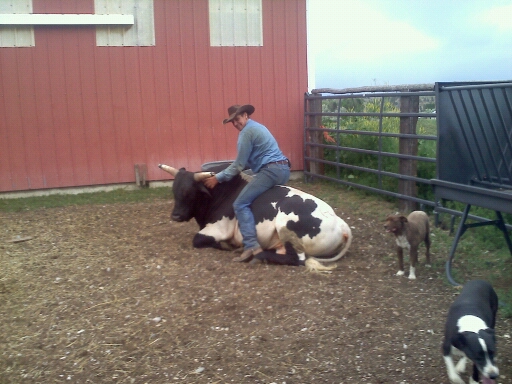
[This is my old buddy “H”. I was so disappointed he didn’t buck. I made hamburger out of him rather than go to salebarn as he would have hurt someone and We didn’t want him to go through it.]
That’s the key to this. The first thing is don’t get one on the fight with the wrong pressure in the first place. If something gets on the fight, and they have the advantage in the fight, you must back the pressure off enough to where you can negotiate or change the mind, before they attack you with the kind of pressure that affects you. If you over pressure and they attack and you must run or hide you will make it much tougher to change the mind as they have learned to pressure you to get out of pressure.
Learning to read when an animal is challenging your pressure is real important.
Learning to not retreat to far to display fear, but not stepping forward to much to display anger is what this is all about.
The most important thing is to stay SAFE. This is dangerous business we are talking about. It is not important enough to get hurt or killed for.
The other thing I remember Bud Williams saying in the grizzly bear story is that the snow machine ran real good and it was full of gas!

 Curt Pate Stockmanship