Category Archives: Learning

Trying to be someone else

I have been watching and participating in horse and livestock handling seminars for a long time.  One of the fascinating things to me is how some of the teachers have such a huge presence and how the followers go from following the craft or skill to making every decision and thought on what the guru would do.

The ones that seem to have the most presence are the ones that are the harshest on the students.  For some reason this seems to create a need to please, and so some seem to worship them to try to get their approval.  I don’t get it.

I always hear statements like I will never be half as good as so and so was.  Why not? And why would you try to compare it on a certain level?  Until you start competing at a competition, it is not about being better than someone else, but to improve your own skill level to the level you are willing or capable of achieving.

In my own situation, I got caught up in this.  I was so enamored by the new skills I was learning and thought it was the greatest thing ever.  After awhile I started to see that I was getting ego-based results that impressed folks and myself.  After some time I started seeing my actions were getting results, but the animals I was working with were not as content with it as I was.  I think I may be a little over sensitive to animals sometimes, so it helped me to question if what I was doing was right.  I felt I was physically doing things one way, but talking about it another.  Just because you have the feel-good words to describe what you are doing, it does not mean you are giving the animal you are working with the best deal.

I watched a real good fellow in the horse industry for several years struggle.  He was an apprentice under a real popular horse guru.  When he finally quit using that person’s name and started doing his own thing, his horsemanship really improved. He went from trying to get work to having more than he can handle. He was able to help a lot more people.  He and his mentor are still friends, but now I think he is helping his mentor with some things.  Isn’t that great?  It’s great on both accounts.  The student for improving and the teacher for still wanting to learn more.

I like to use the greats to inspire me to do things I did not know were possible.  I am no longer interested in ego-based animal interaction. Though I still fall off the wagon once in a while. What I am interested in is learning how to work with animals to improve humans’ quality of life without diminishing the animals’ quality of life.  There are limits to what we can ask of animals to do for us.  We can put the line out there much farther if we learn to work with the animals in a better way, but there is a line.

This is what I think the truly great animal communicators can do for us.  Inspire us.  Help us to not make unneeded mistakes.  Save us time in our learning.

So be yourself, have a strong desire to improve yourself to what you want to be, and don’t be afraid to not do what everyone else is doing.  If everyone is doing it, it may be the easy way out. You will be comfortable because you fit in, but it may not be the best way.

For it to be the best for you, it has to be you not someone else.

~ Curt Pate
Proper pressure

My focus this week is working with bulls. For those of you that don’t work with livestock, I think the same principles apply to people handling. I challenge you to think of handling humans with proper pressure for better results, and hope by reading this it will get you thinking about how to work better with all things with a mind.

The subject this week is proper pressure. When working with bulls not applying and using pressure properly will result in negative results quicker than any other class of cattle.

There are many things to consider when working with a single bull. The distance you work from the bull should be determined by the bull. If you try to work the bull to close and keep the pressure on he will get agitated or find someplace to keep the pressure off (i.e. going in the brush). If you are hesitant, and work to far away the bull will learn very quickly that he is in control and can control the handler.

Most bulls are thicker and more muscular than other types of cattle and can’t bend as easily as others. If you get behind them they can’t see you as well and can’t bend so they either stop and wait for you or they turn and look at you. Either result is negative and creates the need to reapply pressure to start the process over.

You should start the pressure from the side in an area the bull can see you without bending its head and move towards the bull at an angle that keeps the head pointed in the direction you want it to go. You will also need to step forward at an angle that will keep the head pointed in the desired direction. If the head turns, step back immediately, then step forward at the given angle and speed the bull is indicating will work. This is reading the bull. He will tell you what to do if you are observant and can think about what to do at the right moment.

The more you work with a single bull properly, the better he will be to work. You are communicating to the bull that if he moves you will not put more pressure on than he can take. If you work a single bull properly and enough, he will learn to work, and not get as agitated because of this training.

When working a group of bulls it is much different than any other group of cattle. Fighting is the problem. When one bull challenges another bull it causes the bulls to have their minds on the other bull. The other bull puts much more pressure on than the human can safely do so the handler can’t do much until the fighting stops. If you get to a spot that you can get the bulls attention, it is very dangerous because one bull running from or being pushed by another is very fast and hard to get out of the way of. The first few times you handle a group of bulls they will have to have some time to work things out amongst themselves. If you don’t have time and space it can get dangerous. Once the bulls get things worked out, they will be good to handle if you pressure them properly.

By teaching bulls to understand pressure you will actually teach them to fight less, because they have learned to respond and move away from pressure. This relates to other bulls’ pressure as well. It will not eliminate fighting, but reduce it and make it easier to stop once it has started.

From my observations it is very important to learn how to teach bulls to work. Safety is the main reason, productivity second. If you are a professional, these things are important. Make the time to train bulls to work. If I was selling herd bulls I would train them to load in a stock trailer out in the open. This would be so valuable for the purchaser, and would force the herdsman to teach the bulls to take pressure to get them to load. Just an idea …

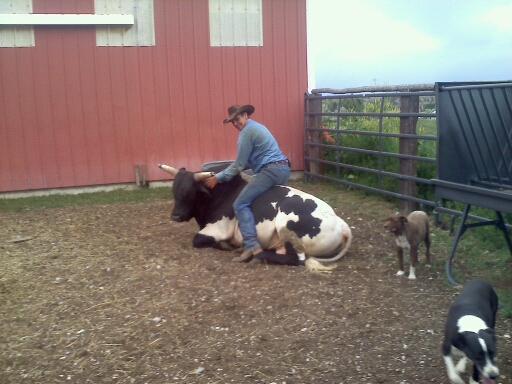
I purchased a bunch of bucking bull yearlings from D&H Cattle Co. a few years back. One of the bulls was a great looking bull but real mean. He was trying to hook the horses when they were bringing them in and when I was feeding would try to hook me when I was taking strings off the bale. I challenged myself to change him. He still gets on the fight if he gets to much pressure, but he seems to enjoy being worked properly and likes to be around me. I really like this bull. He taught me a lot on how to work with an animal that is on the fight.

curt rides cow 2

Curt and the bull named “H”

I can pick his feet up and and scratch him all over, but I am very careful about how I approach him and move him. I like the savvy old saying, “Never approach a bull from the front, a horse from the rear, or a fool from any direction.” Now those are words to live by.

~ Curt Pate

Sustainability and the customer

Last week was the National Cattlemen’s Beef Association’s annual convention.  It’s a big time deal and I am proud I got to be a part of it. I had lots of good experiences, met lots of good folks, and got some new things to think about.

A man from McDonald’s gave an interesting talk on the sustainability commitment that the company has made.  The most interesting thing that I found was that favorable public perception for the fast food giant was very low.  The customer has spoken and they are trying to do something about it.  They may not know exactly what to do, but they are working on it and I bet they will figure it out.

The A&W burger joints in Canada have gone to all natural beef.  They even go so far as to feature the main suppliers and the sustainable practices they use. To learn more about what they are doing check out: www.awbetterbeef.ca

Several companies have been able to already convince or capitalize on the more affluent members of society about sustainability and create or satisfy a customers needs for organic or natural labeled foods.  I did not know if this was a trend or a fad, because it was a pretty niche market.

I used to get kind of a big kick out of going to the natural food store in Helena, Montana to shop with my wife.  We had a big old diesel pickup with a bale bed and brush guard and it would really stand out in the parking lot full of Subarus.

You are supposed to bring your own bags to these stores and I had lots of them from all the cattle trade shows I was involved in.  The trouble was they had been given out by all the drug companies. You will get some looks in the natural health care isle if you are putting natural cold remedies in a bag with a cattle vaccine logo on it.

Just me being in the store with a cowboy hat on created quite a lot of stress.  I would seek out the folks that seemed to be the most opposite of me and ask them questions or try to get them to help me.  Some would be a little hard to catch up with.  At the check out line it was really interesting because so many of the folks had to stay there with me and felt uncomfortable knowing I was a rancher and just maybe a republican.  Most of them had a brace up against me, but if I smiled and asked them some question or complemented them on something they would talk to me, and a few of them would even look at me.

My point is that I was very different in my lifestyle from the people that chose to shop in this store.  They were skeptical of me and I had to make a big effort to change the way they perceived me.

The reusable bag with a medicine bottle and a syringe picture carried by a guy with a cowboy hat and manure on his boots was just as sustainable as the the guy with the tattoos and nose rings and the hemp bag.  I was reusing a bag and expressing my lifestyle through my appearance the same as him.  We may have been more alike than either of us thought. Or maybe not …

It sure looks to me like the sustainable movement is not only here to stay, but is growing at a very rapid pace.  When Walmart and McDonald’s are marketing to the customer as sustainable it’s pretty hard to deny it.

The funny thing is after the seminar I heard lots of negative talk about this whole sustainability thing.  It confuses me as to why beef producers don’t understand that we produce a product for a customer.  Most of us don’t sell directly to to the consumer so we hire someone to do it for us (i.e. Walmart and McDonald’s).  I am pretty sure they know what the customer wants but we don’t seem to want to listen.

Most people don’t see when a bull is on the fight or a horse is going to buck them off, until they have been run over or bucked off a few times.  They just could not see it shaping up.

I don’t know how it’s going to shape up, but sustainability is an important concept for our consumer of beef. If we can’t see this by now we are about to get run over and bucked off hard.

My grandfather always said we need to “separate our wants from our needs.” People don’t have to or need to eat beef.  We in the beef industry “need” to get consumers to “want” to eat beef.  They are telling us what they want and we need to listen.  Enjoy it and profit from it.

~ Curt Pate