I have seen more metal in the last week than you can imagine. I made a long drive North to the Saskatoon Saskatchewan area for the “Ag in Motion ” show. It is a huge display of all things Ag. Acres of farm equipment and livestock handling equipment.
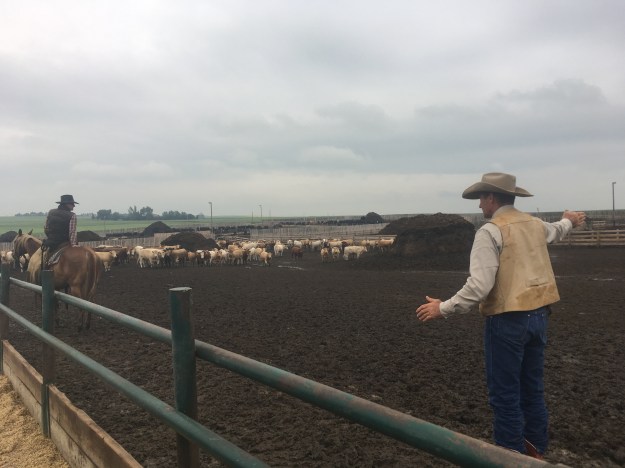
I did two cattle handling demos. It was a challenging place to do a demo, but Tim Andrews brought some real nice limousine bulls that he had really gotten gentle, so they worked well. It’s refreshing to see someone so passionate about his animals and how they are cared for.
As soon as I was done I headed south to get back to Billings to fly out the next day. I drove to Plentywood, Montana and stayed there. It is very dry and the crops look terrible in that part of Montana.
I had a flight to Springfield Missouri to meet Bob Studebaker of Go Bob Pipe, and he was going to take me to Pittsburgh Kansas. Well, my flight was delayed and I talked him into going on and getting some sleep. I got in about 1 in the morning and rented a car and drove over the next morning.
The Four State farm show looked a lot like the Ag in Motion show. It’s not as big a grain area, so most things had to do with cattle and hay production. It was real hot, and by about noon most folks were done shopping.
I hung out in the Go Bob booth. It was interesting watching them work and sell people on the products they offer. Bob is very passionate about life, his equipment, and our connection is cattlehandling. He is very committed to learning and doing all he can to improve and promote cattlehandling. I enjoyed watching it all, and learned a lot.
I consider myself to be a real profit minded producer. I don’t believe in buying things that don’t pay for themselves, and if I can do it myself cheaper and better than someone else, I enjoy working so I will do it myself.
One of the biggest drains on a cattle producer can be “rust, rot, and depreciation ” and the less machinery you depend on the less headaches you have, but you need to have the right stuff to do the job safely and effectively.
With cattle handling I feel you need to figure out the highest pressure points and have equipment that is safe and effective for that pressure. This is usually the squeeze chute. Then the lead up to the chute, then a tub or box to get them in the lead up to chute. The farther you get away from the chute the farther you get away from high pressure. A simple way to allocate funds for handling equipment. Then figure out what your operation can pay for and go from there. Don’t forget about resale value and the safety factor.
I find the improvement of quality in my lifetime of working with squeeze chutes to be very good. The first chute I member was a wood structure that the squeeze was put on by a rope and pulley and tying off to a stake in the ground. I remember my Grandfather putting a big stud horse in it to cut and it completely kicked it to pieces, and when he finished it was just a bunch of firewood.
Next he bought a homemade wood and steel chute that had a ratchet steel squeeze and a sorry sort of head catch. It was a big improvement and a lot safer, but not very good or safe.
My Grandfather Leonard Frank traded lots of cattle, but liked to feed bulls. He would buy thin range bulls and we would feed them chopped hay all winter and sell them in the spring. Most at that time were horned Hereford bulls. After the other chute wore out and broke apart beyond repair, we ended up with a “Teco” chute from the Montana Meat Company.

It was wore out, but quite a big improvement. The head catch was a guillotine type and the teeth were wore out. I don’t remember how many times I was thrown in the air or knocked down because the gate latch didn’t latch, or the head catch didn’t catch. It was downright dangerous to work and I weighed about eighty pounds soaking wet and those bulls threw me like a rag doll. The best thing about that chute was the squeeze. It had a rope you pulled and it was very smooth and released real nice. Someone should start using that squeeze set up again. I have not seen a better one in all the chutes I have seen.
We always had a wedge or “V to bring the cattle into our homemade lead up to the chute. I got real good at understanding how to bring animals, and we didn’t have and adjustable alley so cows and bulls were the only class you could fill the alley up, but you had to be careful because it wasn’t very strong and when wood started creaking you better back off the pressure or it was going to break somewhere. We used poles to keep animals from backing up, and it didn’t take long to figure out what side of the pole to be on in case you didn’t get it through to the post on the other side.
I have so many good memories of me and my Grandfather working in those old wore out corrals. We worked and loaded lots of animals in that old set of corrals. He always had a stock truck, and hauled cattle for people. We would come home from the sale and I would back into the chute and if I hit it to hard I would get a talking to. We were real careful and had to work right because our facilities required it. We had to work our cattle right because we had no way to force them and our facilities wouldn’t take the pressure of animals be forced.
When I walk around and see all the technology and design in the cattle facilities today it is amazing how things have changed in the last fifty years. That old stake in the ground to tie off the squeeze is a long way from the metal and hydraulic remote controls we have today.
From what I see it is so much better for human safety and getting lots done. I am not so sure it is always better for the livestock because of all the pressure we can put on because of the good equipment. What’s good for the human may not always be what is good for the animal or the pocketbook. We need to work our animals like we used to in bad facility’s for the animals sake, and use good facilities for the humans sake.
I did a radio interview in Saskatchewan, and the fellow asked me what gave me the right to come up here and tell people what to do. That was the best question I have ever been asked in an interview. First off they hired me to do it. I have experience and can talk about it. In the past fifty years I have learned good and bad and like to share what I have seen and learned. I understand the difference in positive and negative handling because I’ve done and seen both.
Two different chute photos. At My friend Johny Scott’s we had no one to wrestle this calf, so I came up with this and we go it vaccinated properly. The other was a homemade chute on a place my Father grew up on near Marfa Texas.
Most of the sales people in the Go Bob booth were not experienced in cattle handling. Bob has a passion for animal care and handling, and he has transferred that feeling to his staff. They really care and want to have equipment that is good for livestock and people. That’s why I agreed to hang out with them. They understand how important good Stockmanship is.
I really feel that a lot of the equipment I see could use lots of design improvement. It’s interesting how we can have so many different designs. Just because you have a tub, it doesn’t mean it will work. There are certain designs that will never work. I am sure they will disappear as we get more knowledge spread on what works and what doesn’t. I’ll say this, if the entrance of the snake and the pivot point of the tub gate aren’t pretty close to the same spot you are way more likely to have trouble.
After the show I headed back to Springfield and had some good Mexican food at a little restaurant I like. As I was getting checked in for my flight I heard someone say my name in a strong voice. It just happened to be Trent Johnson of Greeley Hat Works. He had been at PFI, a great western store in Springfield that sell his good hats. We are both United airline snobs so we had a good visit and ended up both in first class. We decided we were the luckiest guys around. Maybe that luck is because we are wearing a Greeley Hat. It was the first time I have ever really got to sit down and talk, as he is quite possibly the busiest guy in America(at least the busiest guy wearing a hat). I enjoyed the visit and am even prouder to be wearing one of his hats.

“Trent Johnson, a first class guy in first class”
I am now headed to Edmonton Alberta for more Zoetis fun. Hopefully I’ll learn something worth sharing!


 Curt Pate Stockmanship