Temple Worship


It was Temple Grandin’s birthday yesterday and I was sent this tribute to her by Ruth Woiwode.  I have watched the relationship between these two and Temple had told me about helping Grad students and I thought she my have helped Ruth.

Ruth is a great young lady that will continue what Temple got started as will many other people that Temple has impacted.  As Temple has proven, one person can make a big difference in quality of life for  animals and humans, but the exponential impacts in the future with all the people she has mentored and inspired will be unmeasurable.


IMG_1997

Good questions

“Thought provoking read, very interesting that even within your family opinion and emotions may differ. Could you inform us a bit more on the subject of the science of Ralgro and other such implants. Also, throughout your travels, are there any cattle yards that head and heal doctor in the pen with long lasting antibiotics in contrast to pulling to a sick pen? Always enjoy your opinion, thanks”

Lorne Hindbo asked the questions above.  I met Lorne at a ranch clinic in Red Deer Alberta a few years ago and enjoyed his philosophy and personality, and his stockmanship skills.  Thank you for two very important questions.

On the subject of roping and doctoring in the pen, yes some do it.  As some of you may know, I enjoy roping, and have worked hard at getting proficient at it.  I think it is more important to get the animal caught without overstressing the animal, and after it is roped, getting it on its side and restrained with out overstressing the animal, than throwing a fancy loop.  For my goals, the herd should also not get stirred up from the roping and doctoring.

In a pasture situation this can be accomplished in many ways, and the herd knows it can move out of the pressure so they get less stressed.

In a pen, if you create lots of pressure the animals can’t exscape the pressure so they get more stress and fear, so each time you doctor something it gets to be more stress. If weight gain is what you are after, it gets harder to settle the cattle and get them to gaining if they are fearful.

Safety becomes a factor in a feedlot pen when roping because of pen conditions. Proper veterinary practices and correct medications are also more difficult in the pen versus the hospital.

There are times and circumstances I feel that it’s a judgement call.  One example is if you have a mud hole that is impossible to get an animal out of at the gate, you would stir the sick animal and the pen up more than roping it.

This is why we need to have protocols and define our goals.  The opportunity to rope may be more important than monetary profit on some operations and then that would change the situation.  Every circumstance is different and the more skills we have, the better we will be at dealing with each circumstance.

I feel the most valuable stockman are the ones that can “get er done” but always do it with the least amount of stress possible and as safely as possible.

As for the Implant science question, I think this article explains it very well.  (My wife still won’t agree)


Industry
The facts about hormones and beef
By Oklahoma State University September 10, 2012

Questions exist in the public sector regarding the safety of consuming hormone implanted beef. In short, the use of supplemental hormones in beef production has been scientifically proven as safe for consumers and is approved by the US Food and Drug Administration (FDA). For those still in question, let’s further examine the science supporting these facts.

Hormones are products of living cells naturally found in both plants and animals that often stimulate cellular activity. There are six hormones approved for use in beef production. Three are natural hormones (testosterone, estradiol, and progesterone) and three are chemically similar synthetic hormones (melengestrol acetate, trenbolone acetate and zeranol).

Growth hormones in beef are primarily administered using a small pelleted implant that is placed under the skin on the back of the ear. The implants are designed to release the hormone slowly over time into the bloodstream. This ensures that hormone concentrations remain constant and low. Since the ear is discarded at harvest, the implant does not enter the food chain. Implants work by increasing the amount of growth regulating hormones, which are naturally produced by the animal. This, in turn, increases feed efficiency, protein deposition and growth rate. Implanted calves usually result in a 10-20% increase in average daily gain (growth rate) compared to non-implanted calves. Moreover, because of the increased feed efficiency, less feed is required which decreases production costs by 5-10%.

Since implant doses are low, the use of implants in cattle has very little impact on hormone levels in beef. Table 1 illustrates that 500 grams (~ 1 lb) of beef from an implanted steer contains approximately 7 nanograms of estrogen compared to 5 nanograms of estrogen from non-implanted beef. Furthermore, there are many common foods that are naturally much higher in estrogen than implanted beef. For example, 500 grams of tofu contains 16,214,285 times the amount of estrogen compared to the same amount of implanted beef. To gain additional perspective on the minuteness of these measurements, nanograms are equivalent to1 billionth of a gram. One gram is roughly equal in weight to 1 small paper clip. If we were to divide the same paper clip into 1 billion tiny pieces, one of those tiny pieces would equal 1 nanogram.


a Nanograms of estrogen per 500 grams of food.

Some consumers question whether consuming beef implanted with hormones can cause cancer or early puberty in children. Hormone implanted beef has never been implicated with adverse health effects in humans. However, height, weight, diet, exercise and family history have been found to influence age of puberty. Furthermore, the amount consumed in implanted beef is negligible compared to the amount the human body produces each day (Table 2).


Regarding potential environmental concerns associated with growth hormones, the FDA has determined that the use of natural hormones in beef does not pose a risk to the environment as the amounts administered to calves are much lower than amounts naturally produced by adult cattle. Regarding synthetic hormones, extensive environmental risk studies have been conducted and the FDA has determined that the use of these hormones will not significantly impact the environment.

Most of the beef produced in the US spend most of their lives in a pasture and are then finished in a feedlot where they are given a grain fed diet. Beef that are finished in a feedlot with the aid of growth hormones require less total land mass, less feed crops and create fewer greenhouse gasses per pound of beef produced compared to non growth hormone pasture based finishing systems.

Consumers that prefer to purchase naturally produced or organic beef raised without growth hormones, should be prepared to pay a premium. Implanted beef reduce the cost and resources required in beef production and that results in lower costs that are passed on to the consumer.

References:

Loy, D., 2011. Understanding hormone use in beef cattle Q&A. Iowa State University Extension. Available at: http://www.iowabeefcenter.org/information/IBC48.pdf

 

Ecliptic pressure

Sort of watched the eclipse in Billings, Montana. Didn’t have glasses, but stopped at Buckaroo Business and they had some that we saw the first part. It was not as big a deal as everyone was expecting, but it was a nice experience . I flew to Denver and the rental car centers were out of cars and the traffic coming back to Denver as I was going out was incredible. It’s good to to be going against the flow at times! My room in North Platte was three times more costly the night of the eclipse than the following night. I would have slept in my car if I would have known. People came from all over the world to see the 2 minutes of total eclipse.

IMG_1984

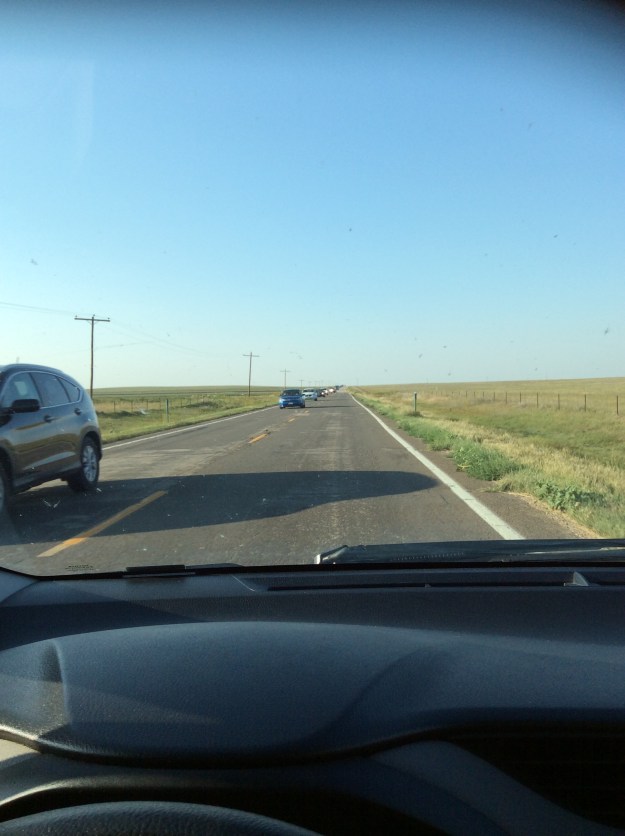
Traffic jam lined up in the middle of Nebraska.


I visited with some guys from a feed yard in Nebraska that were in the total eclipse area and the cattle all bedded down and the birds went in sheds and the crickets chirped. It only lasted a couple of minutes and they were back to normal life.

I spent two days in Nebraska with Stockmanship and Stewardship. I like the people of Nebraska. Rob Eirich is a great presenter for “Beef quality Assurance” and the people that I visit with understand the importance of good stock handling. The people in attendance at North Platte were a mix of feedlot and cow calf. They were a very diverse group from Hispanic pen riders, cowboys, farmers and one young African American news anchor that was real happy to get a nice steak dinner. Good people one and all. I feel real comfortable when in Nebraska.

Next morning we travelled northwest through the very green sand hills and went out in the middle of nowhere to a very nice ranch. The Gudmundsen Sandhills Laboratory hosted their annual open house. Most were cow/calf, but a big diversity of type and size of operations. Family operations to organizations that employed folks to manage resources. Lots of questions on moving pairs properly when young.

When done I drove the four hours back to Denver airport and saw hardly any traffic, but lots of evidence of the thousands of people that had been watching the eclipse just two days before.

I got on an airplane and headed to Winnipeg. Late night and an early morning with Dave Keeley that reps for the Zoetis brand in Manitoba. We always have lots to talk about, lots to do and manage to eat sushi. We usually have the Zoetis lead veterinarian and sushi expert Melodie Chan keeping us on the strait and narrow, but this time we were on our own, so we didn’t eat as well and strayed off the track a little.

The first day we went to a feedyard. Lots of people and lots of ideas. We talked and they worked some cattle, then we shared some ideas on a new facility they we putting in. Then we got in a pick-up truck to check on some cows for just a few minutes. We got back about two hours later and I saw some real nice cattle, some real nice country, heard some real nice stories(I believed some of them), laughed a lot, rolled my eyes a few times, and just really enjoyed myself. I think we were in the hillbilly part of Manatoba, and I really had fun and learned a lot.

Next morning we stopped at ArrowQuips new facility. I think they build real nice livestock handling equipment, and they are always trying to improve life for humans and animals. We visited for a short time and had to get to the Dairy/heifer development yard. This was a very interesting operation as they had interns from several country’s, and were real interested in learning how to work and teach working with cattle better. We started out the day sorting bigger calves out of a pen to go with more calves and finished up the day in the milking parlor, and worked on or visited about everything in between. It was one of the best teaching and handling days, as far as satisfying to me and what I want to do, as I can remember having. I really enjoy working with young Dairy type animals.

As you can see, much diversity in the people that I came in contact with to produce the bovine protein we provide to consumers. I think the extremes in our lifestyles
make us very different than most our customers and sometimes people in the same business, and that makes it hard to relate at times.

My animal relationships for the week were quite varied as well. I rode two real nice horses in Nebraska. As I analyze my horsemanship skills I think I used real good pressure that fit both horses for what I was trying to do. I don’t know if they were any better when I tied them up after I was done, but I am pretty sure they were not worse from me riding them. I feel that is the most important thing to remember in any kind of animal handling. Every time you interact, the goal should be to get better results. I feel this needs to become a way of life.

The cattle the first night were very good to work. We had a big arena to work outside. I really like it when you can show handling cattle in a big area. Then we put them in a set of pens used for the roping chute and they worked real well to demonstrate pen work on foot, then loaded them horseback in the trailer to finish. Real good place to demonstrate. The cattle were not effected by the crowd of 50 or so people. I could pressure the cattle, and they could move away from my pressure to get out of it. They learned that by responding to my pressure, the pressure came off.

The next day we had a set of steers that maybe weighed eight hundred pounds. The crowd was real big on three sides of the two pens. This caused a lot of pressure on the cattle from the crowd. I had to apply lots of pressure to get them to move toward the pressure of the crowd. It was taking more pressure than the cattle could handle, so I had to change my demonstration to fit the situation and used the pressure of the crowd to help sort the cattle by me and teach them to stop their feet from my pressure overcoming the crowds pressure. I felt I did pretty good at giving the crowd what they needed in the demo without causing the steers to much stress. When I finished I stepped off my horse, one of the steers wanted to hunt me a little. He was okay with horseback, but when I stepped off, I was to much pressure and he couldn’t take it off so he was going to take it out. I didn’t challenge him but stepped back just a little a couple of times and he went back to the bunch.

So two very good examples of same person working with two different crowd pressures and the difference it makes. These are very important things to understand.
Cattle are way more sensitive than we give them credit for. The different crowd pressures were very easy to see, but I think we need to see the subtle pressures that effect the way animals and humans interact.

The eclipse of the sun last week is a great example. Humans were willing to put lots of pressure on themselves, other humans and the environment to experience it. If they didn’t have to much negative pressure (traffic, delayed flights, expensive travel) it was good. Cattle just accepted it as it was and lay down and enjoyed the moment, if some human wasn’t putting to much pressure on them. Might be a lesson in that somewhere.